🗓️ Week 05
Aristotle’s Poetics
PHIL343A – Aesthetics
02 Sep 2026
Art Criticism
What is Aristotle’s response to Plato’s various critiques?
Religious
Moralistic
Psychological
Political
Understanding Greek Poetry
Understanding Art
Observing paintings, novels, plays, stories, films, etc.
What are they made of,
how do they work
what purposes do they serve
what are the means by which they serve these purposes
how do peple understand and appreciate them
What roles do they play in our collective historical and collective histories?
Through a technical analysis, we see other questions begin to emerge.
Their metaphysical constituents, theories of language, and knowledge.
1. Definitions
Defining poetry as a general category of representational arts, or mimesis. This category includes visual arts, poetry, music, and dancing.
2. Historical Precedent
The second recognition by Aristotle, is that Poetry has a history.
A part of that history includes literary criticism, and literary history for instance.
He views this history in the contexts of other cultural evolutionary markers such as the cultural evolution of tragedy and comedy.
Mimesis, is an approach to art criticism which did not begin with Aristotle.
3. Establishing Genre Boundaries
The third element of this work includes the establishment and employment of genre.
For Aristotle, genre is a scheme of enquiry that seeks to provide conditions through which mimetic concepts such as media, mimetic objects, and modes are delimited. In other words, he develops:
Conditions for categorizing this class of object
Concepts that relate to this class of object
Modes of inquiry in which to explore items in this class of object
asserts the significance of formal design and unity for both the composition and the appreciation of literary works, and to offer a conception of artistic form which relates it to the organic forms crucial to his understanding of nature. [(hall95?), 10; 50b34-51a6]
Although we might call this approach ‘formalist’, a question arises about the necessity of genre concepts inferred in a particular mimetic example.
For instance, he references Plato’s analysis of mimetic modes in Ch. III of this work.
However, for Aristotle, mimesis is an attempt to understand the broader world, by reference to the human propensity to represent human experiences through fictive representation, and imaginative reenactment.
In this way, Aristotle likely hopes to connect art to human nature as a capacity for human desire to understand universal concepts whether moral, religious, ethical, or relational.
Mimesis, imitation
Poetry as a subject
Epic, Tragedy, Comedy, Dithyrambic, flute and lyre playing
Ilyliad, Odyssey, Metamorphosis, apparently “the mime of Sophron or Xenarchus”. The works of Homer, Aeschylus, Sophocles, Empedocles. They would also have been familiar with Plato’s works such as the Phaedrus and the Symposium for instance.
First difference: Rhythm, language, harmony.
Means, Manner, and Object
Means of Imitation
Consider some categories:
Rhythm but without harmony, drum and dance for instance.
Language without rhythm or harmony, speech and rhetoric. Or language with rhythm but not harmony.
Actions with respect to characters, good or bad.
The objects the imitator represents are actions, with agents who are necessarily either good men or bad – the diversities of human char acter being nearly always derivative from this primary distinction, since the line between virtue and vice is one dividing the whole of mankind. (1448a)
What are the appropriate objects of representation
Appropriate ways we should represent these objects?
The actions of good and bad men
Attributing character to the actions of men
The manner in which it is represented.
Narrative vs character, choose one, or represent dramatically.
The three differences are means, objects, and manner.
Imitation as Telos
Imitation is natural to man from childhood, one of his advantages over the lower animals beings this, that he is the most imitative creature in the world.
He also delights in works of imitation.
- realistic representations, even if they go against our desires.
Types
Epic poetry, tragedy, comedy, dithyrambic poetry, flute playing, lyre playing = modes of imitation
The three main differences
Each type of poetry (art) differ from the other in three ways
Means of imitation
Objects of representation
Manner of their imitations
Is epic poetry denoted by 1, and 2, but not 3?
A brief
A combination of harmony and rhythm alone is the means in flute-playing and lyre-playing, and any other arts there may be of the same description, e.g. imitative piping. Rhythm alone, without harmony, is the means in the dancer’s imitations; for even he, by the rhythms of his attitudes, may represent men’s characters, as well as what they do and suffer.
Species of Imitation
| Harmony | Rhythm | Language | ||
|---|---|---|---|---|
| Imitative Piping | Dance | Speech, Rhetoric | ||
| Harmony | Imitative Piping | flute-playing | ||
| Rhythm | Dance | |||
| Language | Speech, Rhetoric |
Purpose and Telos as a Mimetic Object
Delight
Mental image of beauty
e.g., grandfather, and memory of grandfather
Is one more valuable than the other?
Mental and physical pleasure
Mental pleasure, e.g., memory of grandfather
Physical pleasure, e.g., sight of grandfather
Learning
Learning through pleasure
Why?
Intimacy between our souls and our flesh
Classification of Pleasure
| Mental | Physical | |
|---|---|---|
| Object of higher pleasure | Memory of grandfather | |
| Object of lower pleasure | Sight of grandfather |
But this doesn’t seem right!
Augustine on Music
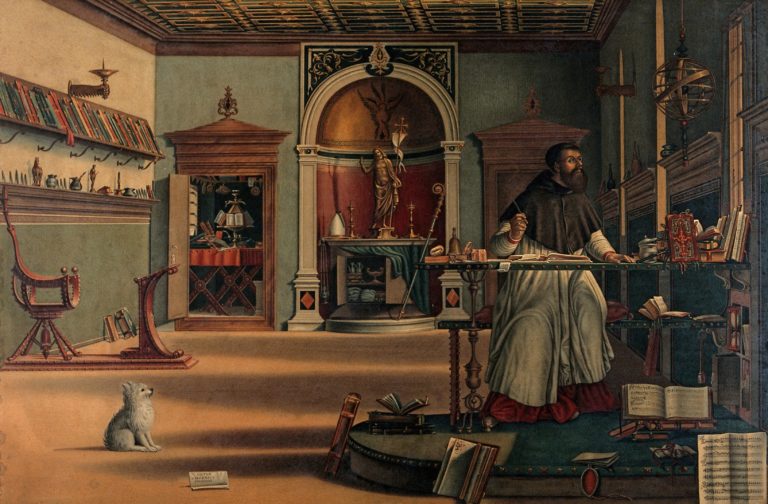
Painting by Carpaccio of Augustine in his study being visited by Saint Jerome
Who was Saint Augustine?
De Musica
We must not hate what is below us, but rather with God’s help put it in its right place, setting in right order what is below us, ourselves, and what is above us, and not being offended by the lower, but delighting only in the higher.
- Perception of the beautiful
- and its constrast against perception of evil
- How to do it?
I think differently about my father whom I have seen and about my grandfather whom I have never seen. My thought of my father comes from memory, but my thought of my grandfather comes from mental movements arising out of other mental movements which are contained in memory.
Our rhythmic or metric art, which is used by makers of verses, comprises certain rhythmical measurements according to which they make the verses.
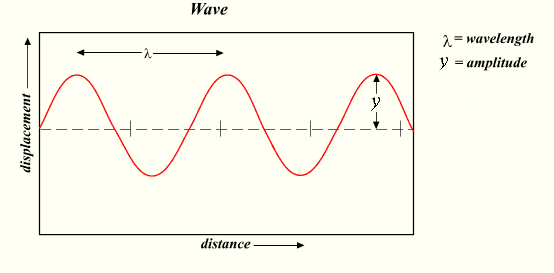
Measurement of wave, distance traveled over period of time
Additionally, what we experience as different sounds, are the different frequencies at which these vibrations occur. In western music, most instruments are tuned to a standard frequency of 440 Hz.

PHIL343A – Aesthetics Aristotle